 Add to Chrome
 Add to Firefox
 Add to Edge
Cross-Stage Attention Multi-Expert Network for Radiologist-Inspired Breast Ultrasound Diagnosis
May 25, 2026
Breast ultrasound imaging is an important noninvasive method for early breast cancer diagnosis, but automatic benign/malignant classification remains challenging due to tumor heterogeneity, blurred boundaries, and data imbalance. To improve feature representation and classification accuracy, this paper proposes the Cross-Stage Attention Mixture-of-Experts Network (CSA-MoE-Net). It adopts a Cross-Stage Attention-enhanced ResNet-18 as the backbone, in which the Cross-Stage Attention module adaptively recalibrates multi-level features, thereby enhancing key tumor features and suppressing redundancy. A three-branch Mixture of Experts (MoE) Block learns complementary features from the Whole Tumor Image, Tumor Core, and Boundary, and an Adaptive Gating Network fuses them to capture morphological, textural, and contextual information. The fused features are denoted as Fused Expert Feature (FEF) in the architecture. Experiments on a balanced dataset of 2,129 breast ultrasound images show that, averaged over 20 independent runs, the model achieves an accuracy of 96.33\%, precision of 94.09\%, recall of 98.53\%, F1-score of 96.25\%, and AUC of 99.50\%. Compared to the baseline ResNet-18, these metrics improve by 3.01, 0.70, 5.37, 2.98, and 5.42 percentage points, respectively. The proposed mechanism requires no invasive modification and can be seamlessly embedded into VGG-16, DenseNet-121, etc., yielding stable performance gains, thus providing reliable support for computer-aided diagnosis.

Cause-Aware Empathetic Response Generation via Chain-of-Thought Fine-Tuning
Aug 21, 2024

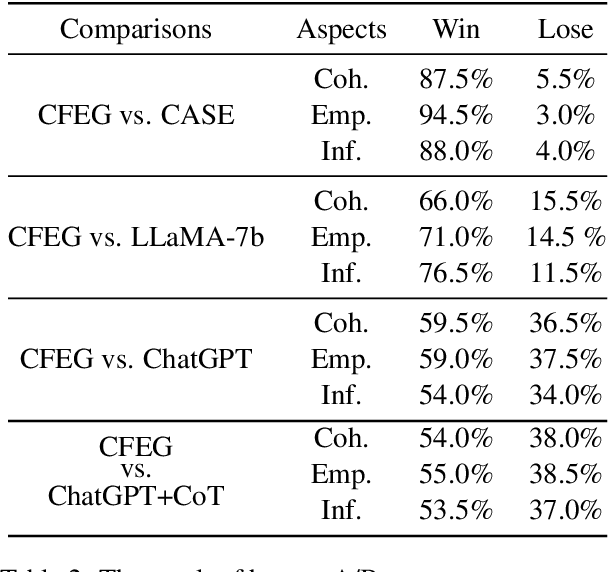
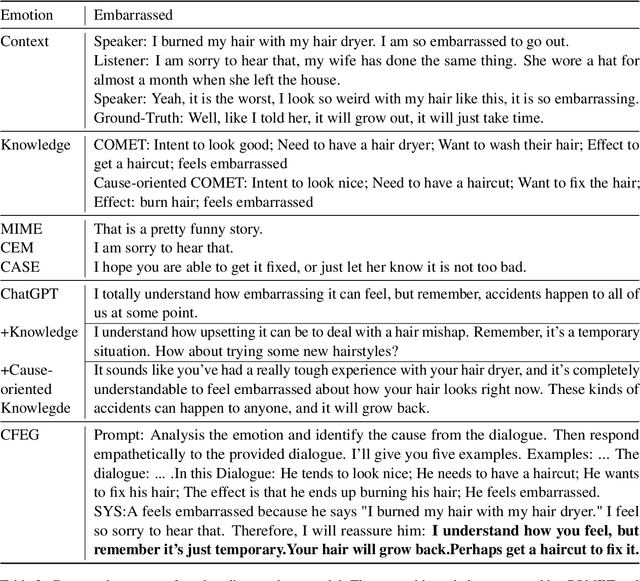
Empathetic response generation endows agents with the capability to comprehend dialogue contexts and react to expressed emotions. Previous works predominantly focus on leveraging the speaker's emotional labels, but ignore the importance of emotion cause reasoning in empathetic response generation, which hinders the model's capacity for further affective understanding and cognitive inference. In this paper, we propose a cause-aware empathetic generation approach by integrating emotions and causes through a well-designed Chain-of-Thought (CoT) prompt on Large Language Models (LLMs). Our approach can greatly promote LLMs' performance of empathy by instruction tuning and enhancing the role awareness of an empathetic listener in the prompt. Additionally, we propose to incorporate cause-oriented external knowledge from COMET into the prompt, which improves the diversity of generation and alleviates conflicts between internal and external knowledge at the same time. Experimental results on the benchmark dataset demonstrate that our approach on LLaMA-7b achieves state-of-the-art performance in both automatic and human evaluations.
S+PAGE: A Speaker and Position-Aware Graph Neural Network Model for Emotion Recognition in Conversation
Dec 23, 2021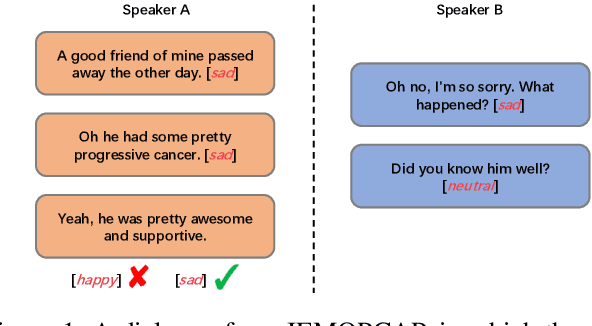
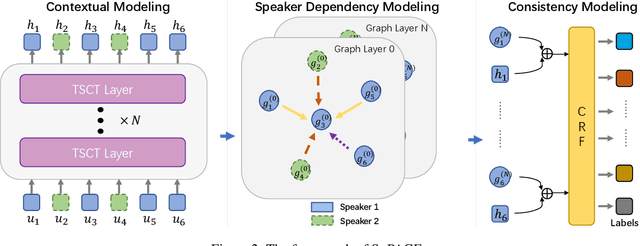
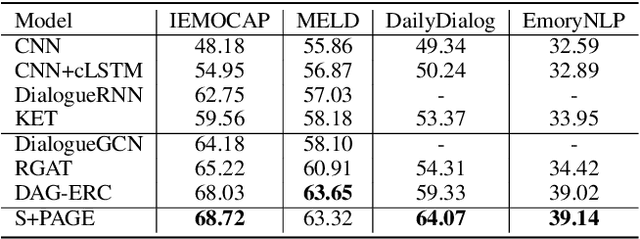
Emotion recognition in conversation (ERC) has attracted much attention in recent years for its necessity in widespread applications. Existing ERC methods mostly model the self and inter-speaker context separately, posing a major issue for lacking enough interaction between them. In this paper, we propose a novel Speaker and Position-Aware Graph neural network model for ERC (S+PAGE), which contains three stages to combine the benefits of both Transformer and relational graph convolution network (R-GCN) for better contextual modeling. Firstly, a two-stream conversational Transformer is presented to extract the coarse self and inter-speaker contextual features for each utterance. Then, a speaker and position-aware conversation graph is constructed, and we propose an enhanced R-GCN model, called PAG, to refine the coarse features guided by a relative positional encoding. Finally, both of the features from the former two stages are input into a conditional random field layer to model the emotion transfer.